Showing posts with label 1940s. Show all posts

Wednesday, January 4, 2017

Old Time Soda Fountains

Illustration by Clarence Underwood (1912)
 
 
The old time soda fountain is one of the most iconic and beloved images of America in the early to mid 20th Century. The counter soda fountain was introduced in 1903 and it quickly became an important part of popular culture, reaching its heyday in the 1940s and 50s.


Soda Fountain Hess Brothers Department Store, Allentown, PA (1913) (Photo courtesy of Wikimedia Commons)


Drugstore and Soda Fountain (Between 1900-1910) (Courtesy of Library of Congress)

Soda fountains were commonly found in pharmacies, ice cream parlors, candy shops, department stores and train stations.


"Soda Jerker" Corpus Christi, TX (1939) Photo by Russell Lee (Courtesy of Library of Congress)


"Soda Jerks" mixed unflavored carbonated water with syrups to make colas and other sodas. They also made ice cream sodas, milk shakes, chocolate malts and egg creams.


"Soda Jerk" (1936) Photo by Alan Fisher (Courtesy of Library of Congress)


Collins Pharmacy, Islip, Long Island, NY (Circa 1915) (Courtesy of Library of Congress)

The classic soda fountain featured goose-neck soda spouts and a large mirror behind a long counter lined with round spinning stools. 


Drugstore Postcard (Circa 1948) (Courtesy of Wikimedia Commons) 


General View of Soda Fountain Area Zaharako's Ice Cream Parlor, Columbus, IN (1974) Photo by Jack E. Boucher (Courtesy of Library of Congress)


Soda fountains became places where tired shoppers and travelers could take a break, and friends and neighbors could meet and socialize, while drinking non-alcoholic beverages. 
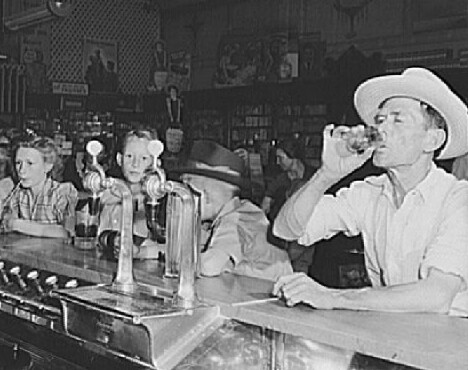


Rushing's Drugstore, San Augustine, TX (1943) Photo by John Vachon (Courtesy of Library of Congress)


The cold sodas and other treats appealed to both children and adults, especially in the summertime, in an era before people had air conditioning at home.


Rushing's Drugstore, San Augustine, TX (1943) Photo by John Vachon (Courtesy of Library of Congress)


Many establishments expanded their menus to include meals. Often booths or tables were added. Some evolved into what became known as Soda Shops or Malt Shops, which often featured jukeboxes, and have been celebrated in comic strips, TV shows  and movies. These were popular teen hangouts of the 40's and 50's, where many young couples would go on dates.


Jim Tillma and Antonette Skoda at the Soda Fountain at the Student Union, University of Nebraska, Lincoln. They Will Be Married in June... (1942) Photo by John Vachon (Courtesy of Library of Congress)

Many people are nostalgic for soda fountains. Some have happy childhood memories of them; others long for a time that seems happier and more innocent. Today most drugstores no longer feature soda fountains, but there are a few still left that honor and celebrate the old traditions. And many retro themed diners, ice cream shops and candy shops are decorated to look and feel like old time soda shops, keeping the spirit of the past alive. 


A "soda jerk" serving an ice cream soda in a century-old diner in Bramwell, WV (2013) Photo by PumpkinSky (link) (CC by-SA 3.0)


Wednesday, February 3, 2016

Norman Rockwell (1894-1978)


Norman Rockwell Illustration From Red Cross Magazine (1918)


Norman Rockwell was a prolific American artist who was born on February 3, 1894. He is most famous for his numerous cover illustrations for magazines including The Saturday Evening Post, Boy's Life, Literary Digest, Leslie's Weekly, The Country Gentleman, Life and Look. His work included illustrations for books, posters and advertisements, and usually featured sweet and wholesome scenes of children, families, and daily life. Although he was not considered a serious artist by many critics, due to his idealized and sentimentalized portrayal of American life, his work was and remains extremely popular. Prints of his illustrations still decorate many homes, offices and public places, and his name is widely recognized. 


Norman Rockwell (1921) (Courtesy of Library of Congress)


In later years, he began to paint more serious subjects, focusing on issues close to his heart, including human rights, racism and poverty.  He painted posters to raise money for war bonds and for charitable causes, and he was commissioned to paint portraits of famous figures including U.S Presidents and other world leaders. 


Poster 1940-Courtesy of Library of Congress


His famous Four Freedoms series was painted in 1943, during WWII, which illustrated the four human rights which President Franklin Roosevelt identified in his 1941 State of the Union Address as essential human rights that needed to be protected: Freedom of Speech, Freedom of Religion, Freedom from Want and Freedom from Fear. These images are not in the public domain, and so are not pictured here. For more information and to view these pictures, please click on the following link: 

The Problem We All Live With is an iconic 1964 painting that depicts a young African American girl during the process of racial desegregation in the south. On her way to her previously all-white school, she is being escorted by deputy U.S marshals due to threats of violence. To view this painting and for more information, please click on the following link: 

Below are some beautiful examples of Norman Rockwell's early work from magazine covers of  the 1910s and 1920s.


source


source


Monday, January 25, 2016

Conserving and Preserving Food- WWI and WWII


WWII Poster


In WWI and WWII, conservation of food was important to the war effort in the U.S.A. and around the world. Citizens were encouraged to be mindful of what they were eating, to buy local foods, and to grow and preserve their own food when possible.  Women's magazines often featured recipes for dishes without wheat, meat or eggs.


WWI Poster (Courtesy of Library of Congress)


Food rationing occurred in some countries during WWI, but did not occur in the USA until WWII. Food and other necessary items were in short supply, and families were issued stamps or coupons to redeem for a limited quantity of foods such as meats, cheese, butter, shortenings and canned goods. Sugar, coffee and gasoline were also rationed. This 1943 photograph from the United State Office of War Information is captioned as follows: "Preparation for point rationing. An eager school boy gets his first experience in using war ration book two. With many parents engaged in war work, children are being taught the facts of point rationing for helping out in family marketing."


Preparation For Point Rationing (1943)- Photo by Alfred T. Palmer (Courtesy of Library of Congress)


The government encouraged the planting of War Gardens or Victory Gardens (the more common term in WWII), which were fruit and vegetable gardens located at homes and in public parks in the U.S., U.K., Canada, Australia and Germany. They helped to supplement the food supply, and also provided a morale boost to citizens who felt empowered by growing their own food. These fresh foods provided much needed nutrition, as well as variety, and people were encouraged to can and preserve their harvests. 


WWII Poster  (Courtesy of Wikimedia Commons)


 After work, Mr. and Mrs.Smith Find Time to Work in Their Victory Garden Behind Their House, Childersburg, Alabama (1942)

 Photo by John Collier (Courtesy of Library of Congress)

 
The following illustrations and photographs were produced during WWI and WWII, and they provide an interesting look at life during those eras. By encouraging moderation in diet, and emphasizing fresh, locally-grown foods, the information they provide is still relevant today.


Magazine Advertisement (1917)


WWI Poster (Courtesy of Library of Congress)


WWI Poster (Courtesy of Library of Congress)


WWI Poster (Courtesy of Library of Congress)


WWI Poster (Courtesy of Library of Congress)


WWI Poster (Courtesy of Library of Congress)


WWI Poster (Courtesy of Library of Congress)


WWI Poster by Charles Dana Gibson (Courtesy of Library of Congress)


WWI Poster (Courtesy of Library of Congress)


WWI Poster- Canada Food Board  (Courtesy of Library of Congress)


Dolly Dingle Paper Dolls by Grace Drayton (1918)


Some Victory Gardeners Showing Their Fine Vegetables. 1942 or 1943 (Courtesy of Library of Congress)


WWII Poster by Peter Fraser (Courtesy of The National Archives-United Kingdom)


  Children With Radishes Grown in the Fairlawn Avenue Victory Gardens
Washington D.C. (May 1943)

  Photo by Joseph Anthony Home (Courtesy of Library of Congress)


WWII  Poster (Courtesy of Library of Congress)