Showing posts with label Food. Show all posts

Saturday, January 21, 2017

Southern Sweet Potato Recipes (1906)


The Little Potato Peeler by Albert Anker (1886) Link


Southern Ways of Cooking A Southern Vegetable
By Anne McQueen
From The Delineator, January 1906
To us of the South...the sweet potato is the staff of life from digging-time in the Autumn till planting time in the Summer. I have just dined with some of our new neighbors--settlers from the North--and they served our favorite yams boiled, and ate them with salt and pepper! They are nice people, and they had a good dinner, with a heap of French dishes--consommés and souffles and frappes, which we simple country folk regarded with admiring awe--but they don't know the first principle of cooking a sweet potato.

That those who are unenlightened may know the possibilities contained in them, I will give some "native" ways of cooking potatoes. If you are camping out or picnicking, there is no better way than to "roas' 'em in de san' " and eat them with ham gravy.


Children of Sharecroppers With Sweet Potatoes Photo by Russell Lee (1938) (Courtesy of Library of Congress)


Ordinarily, we bake them--unpeeled, of course--till they are soft and wrinkled, with candied juice breaking through the skins. To steam or boil them is wasting the Lord's good gifts. Eat them with butter or gravy, or without as you choose, but for goodness sake don't pepper and salt them!

The soft, sweet yellow varieties are best for baking; the dry white kinds for frying or making custards, etc. To fry potatoes, pare and slice rather thin, dropping the slices in salted water; fry well covered in boiling lard, turning frequently till well done. Serve hot--cold fried potatoes are an abomination. Some other ways of cooking them--time-honored Southern ways--are:


Mrs. Adams, Wife of Farmer Near Morganza, Louisiana Preparing Sweet Potatoes for Dinner Photo by Russell Lee (1938) (Courtesy of Library of Congress)


POTATO CUSTARD--One pound potato, same quantity each of butter, sugar and eggs, allspice to flavor. Use half or a quarter of this if you wish, only use the "pound for pound" proportions. Boil, peel, mash through colander, and weigh potato, cream, butter and sugar and mix with it, then add egg yolks well beaten; flavor with spice or any extract you prefer. Add the egg whites beaten stiff and mix well; have your pie-plates lined with good puff paste, pour in the mixture about an inch thick, or less if you like, and bake. Eat cold.

POTATO PUDDING--Two cupfuls grated potato (raw), one cupful sugar, one cupful milk, three eggs, tablespoonful butter, any flavor you like. Set the frying-pan on the back of the hot stove and melt the butter in it. Mix the ingredients together--eggs well beaten--and pour into the hot frying-pan; cook slowly on top of the stove, breaking up the crust as soon as it forms, and stirring it through the pudding. Continue to do this till it is done, which will take about an hour. Eat with whipped cream, or "dry so."

SLICED POTATO PIE--Line the inside of a baking-pan with good pie paste, then pour in a layer of cold sweet potatoes, peeled and sliced; sprinkle thickly with sugar, bits of butter and a little cinnamon-stick. Add another layer, more sugar and butter, and cover with hot water, and half a cupful of good wine; or if preferred, a tablespoonful of good white vinegar. Cover with an upper crust, spread with butter, sugar, and a sprinkling of cinnamon, and bake. This has juice enough without extra sauce.


Illustration by Louis M. Glackens, from Puck (1903)


Wednesday, January 4, 2017

Old Time Soda Fountains

Illustration by Clarence Underwood (1912)
 
 
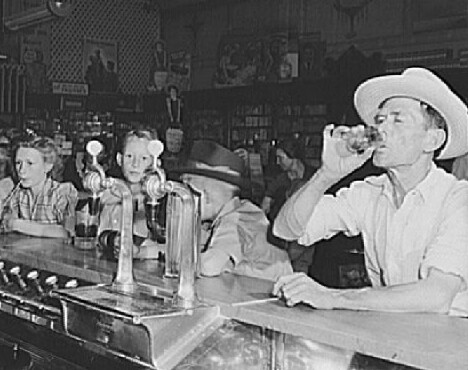
The old time soda fountain is one of the most iconic and beloved images of America in the early to mid 20th Century. The counter soda fountain was introduced in 1903 and it quickly became an important part of popular culture, reaching its heyday in the 1940s and 50s.


Soda Fountain Hess Brothers Department Store, Allentown, PA (1913) (Photo courtesy of Wikimedia Commons)


Drugstore and Soda Fountain (Between 1900-1910) (Courtesy of Library of Congress)

Soda fountains were commonly found in pharmacies, ice cream parlors, candy shops, department stores and train stations.


"Soda Jerker" Corpus Christi, TX (1939) Photo by Russell Lee (Courtesy of Library of Congress)


"Soda Jerks" mixed unflavored carbonated water with syrups to make colas and other sodas. They also made ice cream sodas, milk shakes, chocolate malts and egg creams.


"Soda Jerk" (1936) Photo by Alan Fisher (Courtesy of Library of Congress)


Collins Pharmacy, Islip, Long Island, NY (Circa 1915) (Courtesy of Library of Congress)

The classic soda fountain featured goose-neck soda spouts and a large mirror behind a long counter lined with round spinning stools. 


Drugstore Postcard (Circa 1948) (Courtesy of Wikimedia Commons) 


General View of Soda Fountain Area Zaharako's Ice Cream Parlor, Columbus, IN (1974) Photo by Jack E. Boucher (Courtesy of Library of Congress)


Soda fountains became places where tired shoppers and travelers could take a break, and friends and neighbors could meet and socialize, while drinking non-alcoholic beverages. 


Rushing's Drugstore, San Augustine, TX (1943) Photo by John Vachon (Courtesy of Library of Congress)


The cold sodas and other treats appealed to both children and adults, especially in the summertime, in an era before people had air conditioning at home.


Rushing's Drugstore, San Augustine, TX (1943) Photo by John Vachon (Courtesy of Library of Congress)


Many establishments expanded their menus to include meals. Often booths or tables were added. Some evolved into what became known as Soda Shops or Malt Shops, which often featured jukeboxes, and have been celebrated in comic strips, TV shows  and movies. These were popular teen hangouts of the 40's and 50's, where many young couples would go on dates.


Jim Tillma and Antonette Skoda at the Soda Fountain at the Student Union, University of Nebraska, Lincoln. They Will Be Married in June... (1942) Photo by John Vachon (Courtesy of Library of Congress)

Many people are nostalgic for soda fountains. Some have happy childhood memories of them; others long for a time that seems happier and more innocent. Today most drugstores no longer feature soda fountains, but there are a few still left that honor and celebrate the old traditions. And many retro themed diners, ice cream shops and candy shops are decorated to look and feel like old time soda shops, keeping the spirit of the past alive. 


A "soda jerk" serving an ice cream soda in a century-old diner in Bramwell, WV (2013) Photo by PumpkinSky (link) (CC by-SA 3.0)


Tuesday, March 1, 2016

Smart Shopping 1911


A Picturesque Village Shop, Berkshire, England (source)

Smart food shopping has always been important. Shoppers have always wanted to get the most for their money, while at the same time making sure the food they buy is safe and nutritious. In the early 20th century, there was a growing awareness of the need to be cautious when buying food. Although there were some food purity laws at that time, there was not as much standardization and quality control as there is today. Most stores were independently owned, and some shopkeepers used unscrupulous practices to make money. It was important for shoppers to be aware of such practices so they could avoid them, to buy known brands, and to get to know their local shopkeepers so they could determine who was trustworthy.  The following article appeared in Every Woman's Encyclopaedia, published in England, in 1911. 

Frauds on Shoppers

In this article I propose to deal with food frauds practised by some grocers, provision merchants, and others, whose business it is to retail the food upon which the people live, and I shall endeavour to show the purchaser how she may avoid the fraudulent, and often the dangerous, article palmed off upon her by unscrupulous shopkeepers when she goes a-shopping.


Drinking Coffee (1903) (source)


First I will take an article which is purchased by nearly every housekeeper—coffee. My readers know that when chicory is mixed with coffee the mixture must be labelled accordingly, and must not be sold as pure coffee. How, then, you may ask, can there be any difficulties about that ? Surely we know that we get either coffee or chicory, or a mixture of both ! The law says the packet must be so labelled—what more do we need? But, please, just a moment. How do you know that the stuff mixed with the chicory is coffee, even though it be labelled so? As a matter of fact, there have been cases tried in the police courts which show that, in spite of the vigilance of public inspectors, there are unscrupulous tradesmen who, if they think they are not likely to be found out, will mix anything with chicory, and call it coffee and chicory. 


American Trade Card, Advertising a Trusted Brand of Tea and Coffee (1883)

Recently, the Inland Revenue Commissioners prosecuted a London grocer for selling as coffee something that was very, very different from the real article. Having received complaints from one or two customers, an inspector visited the man's shop. Stowed away in the cellar he found a huge quantity of carefully packed coarse brown powder; it was alleged to be coffee. Investigation brought to light the fact that the powder was a concoction from Germany made from burnt vegetable matter, and that, beyond a deceptive flavouring, there was no trace whatever of the coffee bean in it. Of course, the grocer was heavily fined, as he deserved to be, but that did not alter the fact that a large number of housewives in the neighbourhood had actually purchased from this fraudulent shopkeeper the German mixture, which he had sold for the purpose of making more than legitimate profit.

Postcard (1907) (source)
 
Neither is tea free from the evil work of the unscrupulous trader, although in this case he practises his nefarious work upon the poorer classes only, who purchase tea-dust because they cannot afford tea. But very little of that dust is tea! The factors and tea-blenders sell cases of tea-dust which is perfectly wholesome, but the dishonest shopkeeper is not satisfied with the profit he may make upon this—he sweeps his own shop floors, and adds the darkest of the sweepings to the chest! What dangers to health must lie in those sweepings! Butter was formerly an article that was the subject of endless fraud upon the unwary shopper; but vigorous work on the part of inspectors has brought about a much better and more frequent exhibition of margarine labels.


Girl Eating Bread- Postcard (1904) (source)


The Standard bread agitation has probably done more than any other food movement of recent years towards purifying bread, for in the face of so much attention, both millers and bakers have doubtless been doing their best to "keep their houses" in order, lest the searchlight of the public eye be turned more particularly upon them as individuals than upon bread as a product of food for human consumption. For the moment we may therefore leave bread to the shopper's own discretion, with the note that the consensus of opinion, both medical and otherwise, is that Standard bread is the correct, most nourishing, and natural article.


Of jam, however, a serious note of warning must be struck, and in saying that I do not allude to the products of the several firms whose names are household words, and who have good names to lose, names valued much too highly to be risked for the sake of a little extra profit. The "jam fraud"—if so I may call it—is a particularly artful and pernicious one, one which amounts to a conspiracy between unscrupulous traders and manufacturers. This is how it is worked. A jam manufacturer buys the cheapest fruit he can get; sound or unsound, he does not mind, so that it may be called fruit. If apples are the cheapest fruit he can get, he buys apples and proceeds to turn them into black currant and other kinds of jam. The apples are dealt with in the ordinary jam-making machinery, and then coloured and flavoured with black-currant essence. Pieces of peel and finely chopped core take the place of the small things you expect to find in black currant jam which are in the genuine article—the skins of the fruit. Even the currant essence itself has most likely had very little acquaintance with the fruit after which it is named—it is more often than not a chemical concoction. You see, in the case I have quoted here an actual one, by the way, which was before the police-court—that the manufacturer by these nefarious methods multiplies his legitimate profit on jam-making many times, for whilst the apples may cost him only about £2 a ton, the black currants would probably have cost him more like £20! 


Little Boy With Jam- Postcard (Circa 1910s)

But this class of jam-maker does not put labels on the jars into which he packs his fraudulent "black currant" jam. He has a better way of distributing it than under the cover of his own or firm's name. Instead of this he deliberately sets about conspiring with grocers throughout the country. His travelers go round and offer the retailer the jam at a low price, with the privilege of putting on his own name, and calling the concoction "home-made"! This is just the scheme that pleases the dishonest grocer, for he wants to buy cheaply, he wants to push his name in the district, he wants to make his customers believe that he makes the jam himself—that he has a fruit farm in the country, and a jam factory in town, and so on. And if he be an unscrupulous man he takes the jam with little or no inquiry as to its quality, providing that its taste will pass muster on the palate. Here he is tolerably safe, for, after all, jam is largely purchased for the children. Well, that is the story of how many shoppers are defrauded when they set out to purchase jam. 


Granny Goes Shopping-Postcard (1908) (source)


Of course, if you know your grocer to be a man of integrity, with a well-established family connection in a district where he values his name, you will be proof against this kind of fraud. But do not be led away from the man you can trust by a wondrous display of cheap "home-made jam." Pay a little more and obtain the article which has a reliable name upon it as a guarantee of good quality. 


Illustration by Coles Phillips (1912)


There is no item apparently too small for the attention of the adulterator, for we find cases on record of grocers being fined for selling pepper adulterated with ten per cent of a foreign powder that had no more relation to pepper than a battleship has to a boot. And so the tale might be continued until we had included nearly every item of food and drink. But the examples I have given will, I think, serve to bring home to women who go a-shopping the great care which they must exercise in making their purchases. They should remember that a penny saved is, in reality, ill spent if the result be a long doctor's bill for one of the children particularly fond of jam.


Postcard (1907) (source)

Advice to Buyers: "But," you may ask, " how am I to know when my shopkeeper is defrauding me? The provisions he gives me look all right."
My answer is this:
Firstly: Don't rush too eagerly to the cheapest market. Remember that a good article cannot be produced for nothing. 
Secondly: Deal from a tradesman who has a name to lose, and who has a personality that impresses itself upon you as that of a fair-dealing man.
Thirdly: Make open complaint to your tradesman the instant you suspect him of foul dealing. That will warn him if he is in the wrong; it will be fair to him if you are mistaken. In any case, it will show that you are not the sort of person to be imposed upon with impunity.
Fourthly: Remember that it is a public duty for you to communicate with your local food inspector if you are certain that your tradesman is defrauding you. Your public-spirited action will be of service to others as well as yourself.
Fifthly: In the case of bottled, potted, or tinned goods, buy only the products of well-known makers who have names to lose. In case of complaint, such firms are usually willing to act with all fairness and proper consideration.


Benham's Shop, Cobham, Surrey, England (1912) (A well-known business; the sign outside advertised that it was "established over a century.") (Courtesy of Library of Congress)


From Every Woman's Encyclopaedia, Vol. 4 (1911)

Friday, February 12, 2016

Decorative Menu Designs


Fabric Menu (1889)


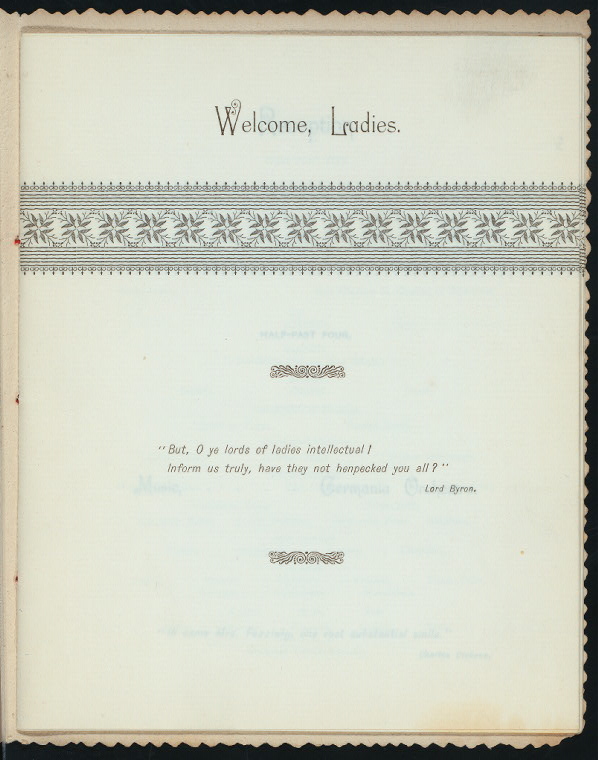
The ornate menu above is from the Dinner for Hon. John Reilly, held at  Charles Duppler's Hotel, New York on November 25, 1889. It is printed on fine pink fabric and contains elaborate machine embroidery. It is from the Buttolph Collection of Menus, part of the digital collections of the New York Public Library, which features an amazing array of menus from the mid 19th Century to 2008. The menus I am featuring are both functional and decorative, and were often intended to be kept as souvenirs. Some commemorate exclusive events; others are menus from ordinary restaurants, trains or cruise lines. The foods served are interesting, as are the prices included on some of the menus. Some are multi-page event programs that feature toasts and songs, and even pages for autographs. There are almost 19,000 items in this collection, so this is only a very small sample, but I have included menus that I found to be particularly beautiful and unusual. 

To explore this collection, please click on this link: http://digitalcollections.nypl.org/collections/buttolph-collection-of-menus#/?tab=navigation


ANNUAL DINNER HELD BY THE NEW ENGLAND SOCIETY 
IN THE CITY OF NEW YORK (1881)


IN HONOR OF WILLIAM MC ARTHUR M.P., LORD MAYOR 
AT THE MANSION HOUSE,  ENGLAND (1881)


BREAKFAST MENU, OCEAN HOUSE HOTEL, NEWPORT, RI  (1881)


THANKSGIVING DAY MENU & PROGRAM, HOTEL DE DIJON, FRANCE (1881)


DINNER MENU,  PUTNAM HOUSE HOTEL, PALATKA, FL (1882)


OHIO SOCIETY OF NEW YORK, AT THE FIFTH AVENUE HOTEL (1886) 
AND DELMONICOS (1891), NEW YORK, NY

(This record contains parts of two different menus, as noted above, that were bound together.)


OPENING OF EGYPTIAN HALL, MASONIC TEMPLE , PHILADELPHIA, PA (1889)


LADIES FESTIVAL DINNER  HELD BY BAPTIST SOCIAL UNION OF BOSTON, MASS (1889)


FIRST ANNUAL DINNER, CONFEDERATE VETERAN CAMP OF NEW YORK 
AT NEW YORK HOTEL, NY (1891)


CHAMBERLIN'S MENU, WASHINGTON, D.C. (1891)


FABRIC DINNER MENU, THE BRUNSWICK (LOCATION UNKNOWN) (1896)


DINNER MENU, MENZIES' HOTEL, MELBOURNE, AUSTRALIA (1899)


DINNER MENUS HAMBURG- AMERIKA LINIE, ENROUTE EXPRESS STEAMER AUGUSTE VICTORIA  AND 
POSTDAMPFER (MAIL STEAMER) WALDERSEE (1899)


THANKSGIVING DINNER HELD BY THE GRISWOLD HOUSE , DETROIT, MI (1899)


HOLIDAY DINNER MENU
NORTH WESTERN RAILROAD LINE
EN ROUTE CHICAGO TO ST. PAUL & DULUTH (1899-1900)


DINNER MENUS NIPPON YUSEN KAISHA SS KOBE MARU 
(INCLUDES MAP OF STEAMER ROUTES)  (1900)


BANQUET AND MEETING HELD BY THE ONCE A YEAR CLUB OF INSURANCE JOURNALISTS, NEW YORK PRESS CLUB, MORTON BUILDING, NY (1901)


CLOTH DINNER MENU OF MR.T. N.JARVIS, RECTOR'S RESTAURANT, NY (1906)


NEW YEAR'S DAY DINNER, GRANDON HOTEL, HELENA, MT (1906)


NEW YEAR'S DAY DINNER, M.F.LYONS DINING ROOM, NEW YORK (1906)


NEW YEAR'S DINNER HOTEL BELLECLAIR NEW YORK (1906)


WALDORF ASTORIA ANNUAL BANQUET,  THE JOBBERS ASSOCIATION OF FANCY DRESS BUYERS (1915)