Showing posts with label 1880s. Show all posts

Sunday, October 15, 2017

Good Looks--The Care of the Hair (1906)

At the Toilet by Harrison Fisher (Circa 1910)


Throughout history, women have often suffered and even died to be beautiful; or that is, to conform to whatever the current standard of beauty was in their particular time and place. From lead-containing face powders in the 18th century (which were actually used by both fashionable men and women, with often disastrous results), to rib crushing corsets in the 19th century, to impossibly high heels, plastic surgery and weight control fads in modern times, the quest for beauty has unfortunately sometimes led to unhealthy practices.


Late 19th Century Trade Card


Like the usually ineffective and often dangerous medicines of the era, hair products of the 19th and early 20th centuries contained various substances, some of which were harmful, and many of which were benign and still found in beauty products today. Some ingredients cleaned and softened the hair, or gave it a pleasant scent. Others made the scalp tingle or burn to make users feel that it was working to stimulate circulation. Common ingredients found in these preparations included soap, borax, glycerin, witch hazel, rose water, bay rum and other alcohols. But some also contained potentially dangerous ingredients such as hydrochloric acid, caustic soda, or lead.


Late 19th Century Trade Card


Hair tonics and shampoos often made wild claims of being able to beautify and restore damaged or thinning hair, enticing women to use their often useless or even toxic products to become more attractive and fashionable. In the late 1800s, the Seven Sutherland Sisters promoted popular hair products, which included a "Hair Grower", "Hair Colorators", and a "Scalp Cleaner". These seven sisters from New York were popular singers and side show performers for Barnum and Bailey's from about 1882 to 1907, known for their exceptionally long, thick hair. Genetically gifted, they sported their lustrous locks long before the formula was even developed. But they were effective celebrity endorsers, targeting women who hoped to grow their own beautiful hair.

In an age where women wore their hair up in public, sensuous, long flowing hair was normally reserved for intimate moments. Such images of extremely long hair seem strange in the 21st century, but in their time they appealed to women's deep desire for sexual attractiveness and love, just like modern ads for beauty products do today. 


A very interesting in-depth article on the sisters, their lives, and their hair care products can be found at peachridgeglass.com. Link


A brief Wikepedia.com article on the Seven Sutherland Sisters with some interesting links can be found here: Link


The Seven Sutherland Sisters (Circa 1890s) On such group photos the sisters were always placed in such a way that it seemed all of the sisters had hair reaching the floor. (Source: Wikimedia Commons) Link

The following article appeared in the advice column "Good Looks" from The Delineator, January 1906, written by a female physician, Eleanor Rogers, M.D. The author gave beauty advice in response to letters from readers of the magazine, which was in line with the latest medical information of the era. While good general health and effective circulation to the scalp are still recognized as being important for healthy hair, many of the treatments recommended by Dr. Rogers would now be considered ineffective and/or extremely dangerous. The hair care tips presented here are for historical interest only, and must not be taken as safe medical advice.


7 Sutherland Sisters Hair and Scalp Cleaner (Source: Joe Mabel at Wikimedia Commons) Link (CC BY-SA 3.0-- Link)


This particular response to a letter on hair care references a substance called cantharides, which was one of the ingredients in the "7 Sutherland Sisters Hair and Scalp Cleaner." Cantharides, also known as cantharidin or Spanish fly, is an irritating substance derived from the secretions of blister beetles. Historically it was used in various preparations an an aphrodisiac, but it sometimes caused injury or death, rather than sexual arousal. In the 19th and early 20th centuries, cantharides was used in some hair care products, as it was believed the irritating properties stimulated circulation to the scalp and promoted hair growth. Cantharides can act as a poison if taken internally and can also cause chemical burns to the skin. It is still used as a therapeutic ingredient in small doses to treat specific skin conditions, but it is no longer readily available. According to Wikipedia, cantharides is classified in the United States as an extremely hazardous substance, and is subject to strict reporting requirements by facilities which produce, store or use it in significant quantities. Link


Miss Grace Sutherland (1889) (Source: Wikimedia Commons) Link


Close Friends by Howard Chandler Christy (1908)


Postcard Image by Howard Chandler Christy (1910)
Sweet Love by Harrison Fisher (1907)


When We Are Together Shooting by Clarence F. Underwood (1906)


Text paraphrased or quoted from Wikipedia.org is presented under the following license: Creative Commons Attribution-ShareAlike 3.0 Unported License https://creativecommons.org/licenses/by-sa/3.0/


Wednesday, February 17, 2016

Historic Images of Atlantic City


Postcard (1908) (Courtesy of tuckdb.org)


In the late 19th and early 20th Century, Atlantic City N.J. became a popular and bustling seaside destination on the Jersey Shore. The city was incorporated in 1854, and by the 1870s and 1880s, it had become a major resort, noted for its famous boardwalk, beautiful beach and elegant hotels, with over 500,000 visitors arriving yearly by rail from Philadelphia and its suburbs. The famous "Saltwater Taffy" was invented in 1883 in Atlantic City.


In the Surf Atlantic City--Stereograph Image (1890) (Courtesy of NYPL)


From the 1900s-1920's many new hotels were built and tourism flourished. People flocked to the beaches and pleasure piers, most notably Steel Pier, and Young's Million Dollar Pier. 


Steel Pier At Night- Postcard (1910s) (Courtesy of Wikimedia Commons)

The Miss America Pageant began there in 1921, and in the 1930's the city inspired the layout of the board for the famous Monopoly game. Atlantic City was billed as a family resort, but there was also a dark side. During the Prohibition Era (1919-1933) there was an increased organized crime presence, and illegal liquor, gambling and prostitution thrived in the city then known as "The World's Playground." 


Travel Poster (Circa 1920s-1930)


After WW2, Atlantic City experienced significant economic decline. The era of legalized gambling began in 1978, and the first casinos were constructed along the boardwalk in the next few years. Many of the famous old hotels were torn down, although a few such as The Chalfonte-Haddon Hall, were incorporated into the new casino complexes that were built. 


Haddon Hall (1902) (Courtesy of NYPL)
  

In the 1990s and 2000s, casino gaming began to expand to other nearby states, including Connecticut, New York, Pennsylvania, Delaware and Maryland. Many people who once flocked to Atlantic City on bus trips or week long vacations now had the option to gamble closer to home, and Atlantic City began to suffer. Many casinos have now closed, and Atlantic City again faces many challenges, but still survives and hopefully will continue to find new ways to bring in visitors in the 21st century. 


Atlantic City Boardwalk (2006) (Photo Courtesy of Wikimedia Commons)

The following photographs and postcard images celebrate the Golden Age of this beloved city by the sea.


Life Saving Lookout Atlantic City (Circa 1900-1920) (Courtesy of Library of Congress)


A Merry Bunch- Stereograph Image (1895) (Courtesy of NYPL)


Entrance to Young's Ocean Pier (1903) (Courtesy of NYPL)


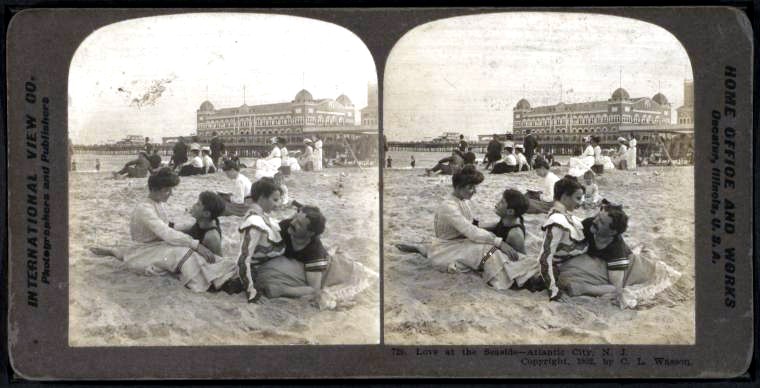
Love At the Seaside Atlantic City- Stereograph Image (1902) (Courtesy of NYPL)
 
The Marlborough-Blenheim Hotel (Circa 1900-1910) (Courtesy of NYPL)


Young's Million Dollar Pier (circa 1910) (Courtesy of Library of Congress)


Menu from Opening Dinner for Young's Million Dollar Pier (1906) (Courtesy of NYPL)

Morning Ride Atlantic City N.J "Where Three Is Not A Crowd" (Featuring Rolling Chairs) (Circa 1910) (Courtesy of New York Public Library)


New York Beauties at Atlantic City Carnival (1922) (Courtesy of Library of Congress)
 
The Pier At the Inlet (1903--Postally Used 1905) (Courtesy of NYPL)

The Sandman (Sand Sculptures) (1900) (Courtesy of NYPL)

The Traymore Hotel (Circa 1900-1910) (Courtesy of NYPL)


 Steel Pier and Boardwalk (Circa 1900-1910) (Courtesy of tuckdb.org)


The Beach (Circa 1900-1910) (Courtesy of tuckdb.org)

The Boardwalk at Night (1902) (Courtesy of tuckdb.org)

Sunday, February 14, 2016

Romantic Dance Couples


To celebrate Valentine's Day, I'm featuring some of my favorite images of romantic dance couples. Couples interact in the dance in a way that mirrors the "dance" of relationships, and in watching dancers we can share in the beauty and heightened emotions that are conveyed. The following images illustrate various dances, including the waltz, the tango, and the mambo, and feature dancers from the early 19th Century to the 1950s. 


Couple In Regency Era Dress-Birthday Card (1905) (source)


Mid 19th Century Sheet Music


Dance In the City by Renoir (1883) (source)


Valentine's Day Card by Ellen Clapsaddle (Circa 1900-1910)

The Ballroom-The Waltz- Stereograph Card (1902) (Courtesy of Library of Congress)


A Dance At the Hyde Park Hotel, London (1907) (source)


"Her Step Was as Light as the Marble Fawn, Dancing the Marble Waltz"- Couple Kisses While Dancing- Stereograph Card (1907) (Courtesy of Library of Congress)


Sheet Music Image (1908) (Courtesy of New York Public Library)


Sheet Music Image (1910)


Sheet Music Image (1911)


Sheet Music Image (1912)

Postcard L. Usabal (1910's) (source)


Postcard L. Usabal (1910's) (source)

Postcard L. Usabal (1910's) (source)

Postcard L. Usabal (1910's) (source)


Postcard L. Usabal (1910's) (source)


Postcard 1910's
 
Postcard 1910s


Dancing Couples, No. 2 By Anne Harriet Fish (1890-1964) (Image Appeared on Cover of Vanity Fair, March 1921) (Courtesy of Library of Congress)


Dance Floor With Couples (1934) (Courtesy of Library of Congress)

Dancing the Mambo (1953)