Showing posts with label 1870s. Show all posts

Wednesday, February 17, 2016

Historic Images of Atlantic City


Postcard (1908) (Courtesy of tuckdb.org)


In the late 19th and early 20th Century, Atlantic City N.J. became a popular and bustling seaside destination on the Jersey Shore. The city was incorporated in 1854, and by the 1870s and 1880s, it had become a major resort, noted for its famous boardwalk, beautiful beach and elegant hotels, with over 500,000 visitors arriving yearly by rail from Philadelphia and its suburbs. The famous "Saltwater Taffy" was invented in 1883 in Atlantic City.


In the Surf Atlantic City--Stereograph Image (1890) (Courtesy of NYPL)


From the 1900s-1920's many new hotels were built and tourism flourished. People flocked to the beaches and pleasure piers, most notably Steel Pier, and Young's Million Dollar Pier. 


Steel Pier At Night- Postcard (1910s) (Courtesy of Wikimedia Commons)

The Miss America Pageant began there in 1921, and in the 1930's the city inspired the layout of the board for the famous Monopoly game. Atlantic City was billed as a family resort, but there was also a dark side. During the Prohibition Era (1919-1933) there was an increased organized crime presence, and illegal liquor, gambling and prostitution thrived in the city then known as "The World's Playground." 


Travel Poster (Circa 1920s-1930)


After WW2, Atlantic City experienced significant economic decline. The era of legalized gambling began in 1978, and the first casinos were constructed along the boardwalk in the next few years. Many of the famous old hotels were torn down, although a few such as The Chalfonte-Haddon Hall, were incorporated into the new casino complexes that were built. 


Haddon Hall (1902) (Courtesy of NYPL)
  

In the 1990s and 2000s, casino gaming began to expand to other nearby states, including Connecticut, New York, Pennsylvania, Delaware and Maryland. Many people who once flocked to Atlantic City on bus trips or week long vacations now had the option to gamble closer to home, and Atlantic City began to suffer. Many casinos have now closed, and Atlantic City again faces many challenges, but still survives and hopefully will continue to find new ways to bring in visitors in the 21st century. 


Atlantic City Boardwalk (2006) (Photo Courtesy of Wikimedia Commons)

The following photographs and postcard images celebrate the Golden Age of this beloved city by the sea.


Life Saving Lookout Atlantic City (Circa 1900-1920) (Courtesy of Library of Congress)


A Merry Bunch- Stereograph Image (1895) (Courtesy of NYPL)


Entrance to Young's Ocean Pier (1903) (Courtesy of NYPL)


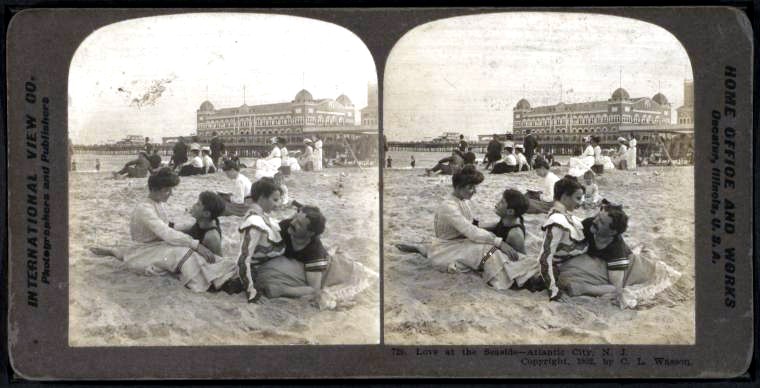
Love At the Seaside Atlantic City- Stereograph Image (1902) (Courtesy of NYPL)
 
The Marlborough-Blenheim Hotel (Circa 1900-1910) (Courtesy of NYPL)


Young's Million Dollar Pier (circa 1910) (Courtesy of Library of Congress)


Menu from Opening Dinner for Young's Million Dollar Pier (1906) (Courtesy of NYPL)

Morning Ride Atlantic City N.J "Where Three Is Not A Crowd" (Featuring Rolling Chairs) (Circa 1910) (Courtesy of New York Public Library)


New York Beauties at Atlantic City Carnival (1922) (Courtesy of Library of Congress)
 
The Pier At the Inlet (1903--Postally Used 1905) (Courtesy of NYPL)

The Sandman (Sand Sculptures) (1900) (Courtesy of NYPL)

The Traymore Hotel (Circa 1900-1910) (Courtesy of NYPL)


 Steel Pier and Boardwalk (Circa 1900-1910) (Courtesy of tuckdb.org)


The Beach (Circa 1900-1910) (Courtesy of tuckdb.org)

The Boardwalk at Night (1902) (Courtesy of tuckdb.org)

Saturday, February 13, 2016

3-D Images--Stereograph Cards


Colossal hand and torch "Liberty" (1876) (Courtesy of Library of Congress)


The historical image above is a stereograph which shows the torch and part of the arm of the Statue of Liberty, on display at the 1876 Centennial Exhibition in Philadelphia. An information booth is at base of arm and two persons are seen at the railing below the flame of the torch. Stereographs consist of two photographic images of the same object taken at slightly different angles, which when viewed together, produce the illusion of a single three-dimensional image. They are usually usually viewed through a device called a stereoscope. 


Reproduction Holmes Stereoscope (Photo by Davepape source )


People were fascinated by these early 3D images, and the success of the stereoscope led to the development of later devices such as the View Master, introduced in 1939, and the production of 3D films, which first became popular in the 1950s. Stereograph cards were produced from the 1850s to the 1940s, and featured various subjects. Many featured staged scenes of everyday living, including leisure, celebrations, family life, humorous interactions and  romantic interludes. Other popular topics included portraits of presidents and celebrities, artistic images, the natural world, business and industry, interesting people and places, news and human interest stories and military life.


The Stereograph As An Educator (1901) (Courtesy of Library of Congress)


Most stereograph images are black and white or sepia toned, but some were hand-colored. The images presented here are from the collections of the Library of Congress and the New York Public Library. Some portray both images; others show only the right or left photo. Stereographs, like other photographs, preserve important historical images, and also offer a glimpse into many aspects of life in years gone by.


Everyday Images


Reading Together (Between 1867 and 1873) (Courtesy of Library of Congress)


I'd Rather Sleep Than Eat (1905) (Courtesy of Library of Congress)


My Protector (1906) (Courtesy of Library of Congress)


Bliss Disturbed (1880) (Courtesy of Library of Congress)


The Ballroom--Salute Partners (1902)

A Ball-Room Scene In Colonial Days--Our Great-Grand-Parents Were Young Once Too (1900) (Courtesy of Library of Congress)

A Glance Through the News (1906) (Courtesy of Library of Congress)


Eavesdroppers (1906) (Courtesy of Library of Congress)


Couple In Fairmount Park, Philadelphia, PA (Between 1870 and 1890) (Courtesy of Library of Congress)


Dressing the Bride (1907) (Courtesy of Library of Congress)


The Wedding Dance (1907) (Courtesy of Library of Congress)

  Presidents and Celebrities


President Roosevelt Ready To Enter Yellowstone Park (1903) (Courtesy of Library of Congress)

Ex-President Roosevelt in the Campaign of 1912 (Courtesy of Library of Congress)


Christine Nilsson, Swedish Soprano (1874) (Courtesy of Library of Congress)

Artistic Images

 
The Girl In the Moon (1923) (Courtesy of Library of Congress)


Adam and Eve #15 (1923) (Courtesy of Library of Congress)

 
The Birth Of A Pearl (1923) (Courtesy of Library of Congress)


The Natural World


The Wawona tree, Mariposa Grove, Yosemite Valley, Cal. (1918) (Courtesy of Library of Congress)


Large Black Bear Getting Into Garbage Cans At Yellowstone National Park (1905)
(Courtesy of Library of Congress)


A Wilderness of Sand--Miles From Human Habitations, Painted Desert of Arizona (1903)
(Courtesy of Library of Congress)


Full Moon (1898)
(Courtesy of Library of Congress)


Business and Industry  


Steamer Loading Cotton, Mobile, Alabama (Undated) (Courtesy of The New York Public Library)


The Hot Dog Man, Luna Park, Coney Island, New York (1904) (Courtesy of Library of Congress) 
 

D. Appleton & Co., Stereoscopic Views and Implements Showroom, NY (1870s) (Courtesy of Library of Congress)
 

Filling Our Orders, B.W. Kilburn & Co's Stereoscopic View Factory
Littleton, N.H. (1905) (Courtesy of Library of Congress)


Landing and Scaling Logs, Aroostook Woods, Maine (1903) (Courtesy of Library of Congress)


Inside A Knitting Factory, Leicester, England (1923) (Courtesy of Library of Congress)


Interesting People and Places


Avenue of Date Palms, Honolulu, HI (1920) (Courtesy of The New York Public Library)

 
Court C Temple of Luxor, Egypt (1908) (Courtesy of Library of Congress)

 
Geisha Girls Dancing, Japan (1908) (Courtesy of Library of Congress)


Cowboys At Dinner, Arizona (1907) (Courtesy of Library of Congress)


Musicians, Russian Carnival, Petrograd (now St. Petersburg), Russia (1919) (Courtesy of Library of Congress)


Bird's-eye view of World's Fair grounds and Festival Hall, from the Buffalo Tower, St. Louis World's Fair (1904)  (Courtesy of Library of Congress)


The Fallen Monarch, Mariposa Grove, Yosemite Valley, CA (1897) (Courtesy of The New York Public Library)


Broadway, New York City, NY (1897) (Courtesy of Library of Congress)


 News and Human Interest


Kearney St. and Hall of Justice After the Great Disaster, San Francisco (1906) (Courtesy of Library of Congress)


Emergency Hospital in Anthracite Coal Mines,  Meadville, PA, (between 1900 and 1920)
Summary: One man bandages head of injured man while another bandages his arm.
(Courtesy of Library of Congress)

  
Military Images


Civil War--"Destruction Of A Railroad Bridge" (Photo shows a smoldering railroad bridge on the North Ana River in Virginia. Confederate troops destroyed the bridge to slow down advancing Union soldiers)  (1864) (Published Later) (Courtesy of Library of Congress)


Destruction Of A Railroad Bridge (Back of Card) (Courtesy of Library of Congress)

 
Civil War--"Hard Tack" (Photo shows Union Captain J. W. Forsyth, the Provost Marshall, sitting on a crate of hardtack, a cracker like bread served to soldiers, at Aquia Creek, Virginia. Crate says "50lbs. net. Army Bread from the Union Mechanic Baking Company, 45 Leonard St.") (February 1863) (Published Later) (Courtesy of Library of Congress)


Russo-Japanese War--Soldier's Barber Shop In Japanese Camp (1905) (Courtesy of Library of Congress)