Showing posts with label Light. Show all posts

Sunday, January 17, 2016

The Dirty Windows

Photo by Kay Isabedra (Courtesy of  deathtothestockphoto.com)

This past week, everybody in America was playing the lottery. The Powerball jackpot was at a record breaking amount of over 1 Billion dollars, and we were all dreaming of the wonderful things we would do if we won. 

But there are numerous stories of people who have won the lottery, and didn't live happily ever after. Some have even said that it was the worst thing that ever happened to them. The money disappeared after being spent on mostly useless things, or people were taken advantage of, and relationships dissolved. 

Of course we need enough money to live and be comfortable, but having lots of money does not lead automatically to happiness. So much of what happens to us is based more on our perceptions of things than on external circumstances. Some people move through what seem to be difficult circumstances with grace, and remain grateful for what they have. Other people seem to have everything on the surface, but are only able to see what they don't have, and don't enjoy their lives or use their talents.  

One sure way to ruin potential happiness is to worry incessantly, and it's difficult not to do that. It's easy to become isolated and overcome by our fears. So when a friend comes along to help, and offers us a fresh perspective, we have the choice to open ourselves to the light, and to new possibilities, or we can stay stuck in the darkness of self-defeating thoughts and behaviors.

The following is a slightly modernized adaptation of a story called "The Windows", which is from a book called The Golden Windows: A Book of Fables for Young and Old, by Laura E. Richards, first published in 1903. 

The Dirty Windows
     
      A man who lived alone was sitting in his room one day, thinking gloomy thoughts.
     “I cannot see as well as I used to,” he said to himself. “I can hardly see to do my work anymore.  It’s evident that my sight is failing. I will probably be blind before long, and unable to do any work! And then I will have to starve to death, or go live in a shelter to survive. Perhaps it would be better for me to go there now, while I can still see a little.”
     Just then his neighbor, who was an emotional, energetic woman, came over to visit.
     “Why do you just sit here, withering away?” she asked, with concern.
     So the man told her his thoughts: how his vision was failing and he how he would soon have to starve to death or go to live in a shelter. And while he was talking, she bustled about the room, filling a bucket of water, and rummaging through the drawers of his dresser to find a clean cloth.
     When he had finished talking, she said; “Look! Your windows are dirty; that’s all that’s wrong.” And she cheerfully washed the windows. “There!” she said, and went about her business, hoping that she was leaving him in a better state than she had found him.
     But with the windows clean, the man was even more upset than before. “Oh no,” he thought to himself, “how this glare hurts my eyes! My eyes must be weaker than I thought!” And he shut the curtains in despair.

--By Susan Sherwood, (Adapted from The Golden Windows by Laura E. Richards, 1903)
 

Saturday, January 16, 2016

Vincent van Gogh

Vincent van Gogh Self Portrait At Easel (1888)


Vincent Willem van Gogh (1853-1890) was a Dutch-born Post-Impressionist painter whose work was highly influential on 20th century art. He is often considered the greatest Dutch painter after Rembrandt, and is one of the greatest and most widely known Post Impressionist painters. 


The Starry Night (1888) (Courtesy of  wikiart.org)


After years of struggling with mental illness he died at age 37, from what is believed to be a self-inflicted gunshot wound. The nature of his mental illness and how significantly it affected his work has been widely debated. There has been much debate as to the source of van Gogh's illness and its effect on his work. Possible diagnoses include schizophrenia, bipolar disorder, syphilis, epilepsy and even poisoning from swallowed paints. Any of these could have been the cause, aggravated by malnutrition, overwork, insomnia, and excessive alcohol use. 


The Night Cafe (1888)


In spite of his illness, his paintings showed great skill and beauty. Most of his best-known and loved paintings were completed during the last two years of his life. In just over a decade, he produced more than 2,100 artworks: these included more than 1,300 watercolors, 860 oil paintings, and also many drawings, sketches and prints. 


Still Life Vase With Fifteen Sunflowers (1888)

He began to draw as a child but did not paint until his late twenties. He worked for a firm of art dealers, and then became a teacher in England. A deeply religious young man, he aspired to be a pastor at one time, and began working as a missionary in a mining community in Belgium in 1879. He began to sketch the local people, and in 1885, painted The Potato Eaters, his first major work.  His painting at the time employed mostly earth tones, and had not taken on the bold, vivid coloration of his later works.


The Potato Eaters (1885)


In 1886, he moved to Paris, where he discovered the French Impressionists, and met and worked with many other artists. In Paris, he painted portraits of friends and acquaintances, still-life paintings, and scenes of the city and of the Seine. During his stay in Paris, he collected hundreds of Japanese ukiyo-e woodblock prints. Some of these prints are visible in the backgrounds of several of his paintings. In his 1888 Portrait of Père Tanguy, several of these prints can be seen hanging on the wall behind the main figure. 


Portrait of Pere Tanguy (1888) (Courtesy of wikiart.org)

In Paris, he lived for a time with his brother Theo. Theo owned an art gallery on Boulevard Montmartre.  The relationship between the brothers was stormy, and although the two eventually made peace, Vincent moved to a northern suburb of Paris in 1887, where he was influenced by Pointillism, a technique in which a multitude of small colored dots are applied to the canvas in such a way that an optical blend of hues is created when they are viewed from a distance. This style utilizes complementary colors, such as blue and orange, to form vibrant contrasts which are enhanced when they are juxtaposed. 


Suburbs of Paris (1887) (Courtesy of wikiart.org)


In 1888, Vincent moved to Arles in the south of France and was influenced by the intense sunlight of the region. Here he began to paint with brighter colors, and he developed his unique and recognizable style.   


Vincent's Bedroom At Arles (1888)


He moved to Arles hoping to find refuge from his personal struggles, including illness brought on by excessive drinking and smoking. In Arles, he was inspired by the light and the local people and scenery. 


Cafe Terrace Place-du Forum Arles (1888) (Courtesy of wikiart.org)


He worked for a time with artist Paul Gauguin. They both found inspiration in Arles, and  often painted together. But they had a tumultuous friendship, and soon considerable tension grew between them.


Van Gogh Painting Sunflowers by Paul Gauguin (1888) (Courtesy of wikiart.org)


Vincent's mental illness was worsening, and in December 1888, he infamously cut off his left ear, and was hospitalized. It is unknown what led to this event, but it is speculated that it may have been the discord between he and Gauguin, or it may have been a romantic disappointment involving a local prostitute.


The Grounds of the Asylum (1889) (Courtesy of wikiart.org)


He returned home in January 1889, but suffered from hallucinations and delusions that he was being poisoned, and had to keep returning to the hospital. In May 1889, he entered a mental asylum in Saint-Rémy-de-Provence.


Green Wheatfield with Cypress (1889) (Courtesy of wikiart.org)


The hospital is located in an area of cornfields, vineyards, and olive trees. During his stay, the hospital interior and its garden became the main subjects of his paintings. Some of the work from this time is characterized by swirls, including one of Vincent's best-known paintings, Starry Night. He was allowed short supervised walks, which led to paintings of olive trees and cypresses that were part of the local landscape. 


Starry Night (1889)


In the last year of his life, he had episodes where he found it impossible to paint, due to his hallucinations and depression. In May 1890, Vincent left the clinic in Saint-Remy to move to Auvers-sur-Oise. He wanted to be nearer to his brother Theo, and also to the physician Dr. Paul Gachet. The doctor had treated several other artists and was himself an amateur artist. 


Dr. Paul Gachet (1890) (Courtesy of wikiart.org)


Although suffering with severe mental illness, he continued to be a prolific painter. In the 70 days he spent in Auvers-sur-Oise, he was able to paint approximately 70 oils, which continued to show innovation and creative intensity. Wheat Field with Crows, painted in July 1890, one of his last paintings, is an example of the use of double square canvases that he developed in the last weeks of his life, in which he paired two square blank canvases to form a single, larger canvas. 


Wheat Field With Crows (1890)


On July 27, 1890, Vincent is believed to have shot himself in the chest with a revolver, although no gun was ever found, and there were no witnesses. After the shooting, he sought medical attention, and was able to walk back to his apartment after the shooting. Two physicians saw him, but without a surgeon present the bullet could not be removed. The following morning, Theo rushed to be with his brother as soon as he was notified. Within hours of Theo’s arrival, Vincent began to fail due to an untreated infection caused by the wound, and sadly died later that evening.


Red Poppies and Daisies (1890) (Courtesy of wikiart.org


He did not achieve fame or fortune in his lifetime, and had no idea when he died how influential his work would become to modern artists. In recent years, his paintings have sold for record breaking amounts, and reproductions of his art can be found on posters, calendars, and other gift items, as well as online, and continues to inspire millions of people around the world. This beautiful song from 1972 by Don McLean pays tribute to this wonderful artist. Please click on the link below to view a video which displays the song lyrics against a slide show of many of van Gogh's most beautiful paintings.


Thursday, January 14, 2016

The Candle In the Window


The Candle In the Window

     There was a little white candle in the kitchen of a house by the sea. It stood on a high shelf, for its days of usefulness were past. It was forgotten and covered with dust. There had been a time when it had given out its light into the darkest corners of the kitchen in the house by the sea.
     All  was changed now. From the power house miles away came the electric current which lighted all the houses on the coast. It sent beams from the lighthouse to the ships, to guide them safely into the harbor.
     "Times have changed," thought the half-burned white candle, its sides bulging with tears of melted wax. "My life is over. I am useless!" The tears would not flow, they only hung like frozen icicles.
     One night a great storm lashed the coast and white-crested waves broke over the shore line in a fury. The stinging rain beat against the windows like lead pellets. An anxious woman gazed quietly toward the sea. Somewhere out there was a fishing boat carrying her husband and sons. She pressed her face close to the pane and watched for a flash from the lighthouse. That light had never failed, and tonight it was the only hope for storm-tossed seamen.
     It was hard for her to see through the rain-drenched window. It was very dark outside. She continued to look until at last she knew--there was no light! The lighthouse beam had failed! She turned away from the scene in despair, and as she did so, the electric light in her kitchen went out. The fishing hamlet was in total darkness. The power plant miles away had been cut off by the storm.
     What should she do? She thought of the old candle! It would not do very much good, but it would keep her company through the night. It was better than nothing. She groped her way to the shelf where matches were kept. She found the candle, blew the dust off its tip, and lighted it. It flickered faintly, then broke into a clear yellow flame. She had forgotten just how much light a little candle could send out. The window caught the reflection bright in contrast to the darkness outside. 
     "Out there the boats are being tossed about," she thought. "Will my fishermen be able to make the harbor? How can they without a light?" She was in great anxiety. There must be some way to help them.
     Suddenly an idea came to her, and she went into her room and came back with a small mirror. She set the candle on the window ledge and placed the mirror in back of it. At least the tiny rays would appear a little brighter to whomever might see them.
     Dawn came and the little candle gave one last sputter and burned out. The wind and rain subsided when the woman saw several figures struggling along the beach. She ran out to meet them. 
     "We rode out the storm, Mother," one of them called. "Somewhere we saw a small ray of light. We rowed for it and it brought us in to the right place."
     "It must have been the candle," she said. That was the only light in the hamlet."
by Edna J. Robb, from Sunshine Magazine, June 1957


Friday, January 8, 2016

A Warm Place

Photo Courtesy of splitshire.com

An evening of sweet contentment at the end of a busy week...a golden place outside of time where worries and concerns melt away, and friends are truly happy in each others company. Sometimes we try too hard to create these special moments. The magical times in life that we always remember often come when we least expect them. The following passage is a remembrance of a warm, happy get together with a group of seemingly random friends almost 100 years ago, on a rainy night in California....


Roses and Rain

     Last night we sat in the quiet room--a few friends together--and heard the wind rattling the palm leaves outside in the garden, like some ghostly senorita clicking a pair of invisible castanets in tune to some haunting rhythm.
     The fire burned on the hearth, a fire of eucalyptus logs, with now and then a branch of aromatic leaves, flaming suddenly into leaping life and filling the room with their pungent and somehow exotic perfume.
     We put out the bright lights from the center of the room, and let the shadows fall from the little gleaming lamps that are like fire-flies, flitting in the dusk like so many swiftly passing thoughts and pleasant memories.
     There we were, the young couple so dead in love with each other, and so full of the joy of living. Sweet Sixteen, a little terrified at her vague glimpse of life—Twenty-one, virile and modest and somehow eagerly hopeful.
     The Home Woman, the Woman of the World, the Artist, the Genius, the Singer and the Priest. A strange company, strangely mixed, and yet there we sat in the quiet little room—together, like passengers on a raft picked up from the wild sea and held together by some strange accident of fate.
     We talked, not of politics, not of war or of diplomacy—not even of the high cost of living, or of the effect of the vote upon women.
     We talked of books and poetry, and of music, and one told a quaint little story of a wounded pigeon, and the rescue of it, and the fire burned and the wind sang, and gradually the stress of the world and the anxiety and restless, uneasy ambition of it fell from us like an outworn cloak. And there we were, like little children, talking together in the twilight of some great primeval forest.
     And one sang—a simple song of love and memory and tears.
     “Roses and rain” and the Artist smiled, and the Woman of the World sighed, and there were tears in the eyes of the Home Woman.
     The Genius it was who sang—and the Singer sat by the fire and listened.
     The Young Wife’s hand stole to the hand of her Husband, and the Priest sat like one in a deep reverie. Was he thinking of the roses that bloomed in the dooryard of his home across the sea, and the fragrance of them in the sweet June rain?
     And we didn’t care who was elected or who was defeated, and somewhere, far down in the city below, the (news) boys were calling “extra, extra, extra!”—all about something or other very important, which concerned us not in the very least.
     And the Singer was generous, and poured out for us like a libation on the altar of friendship his voice of molten silver—French songs he sang full of the quick and glancing grace of a fountain leaping in the moonlight. German lieder, simple and brooding, like the lullabies a mother sings to her child. Italian, too, he sang, and the room glowed with the fire and the passion of the melting music of Italy.
     “Eileen Allana”—how he sang it—the simple old ballad, and how we drank every lilting note of it, like thirsty travelers in a dry and arid desert.
     And so the quiet evening spent itself, and at the end she sang again, the woman with the strange dark eyes—“Roses and Rain”—and we were one with the sunshine and the dew and knew again the sweet and rapturous pang of youth and moonlight and the mystery of the stars.
     “Roses and Rain”—the wind in the palm trees, the fire on the hearth, dear faces in the soft dimness of the quiet room. What is there sweeter, what more beautiful, what more to be gained in life than these?
 --from Roses and Rain by Annie Laurie (1920)


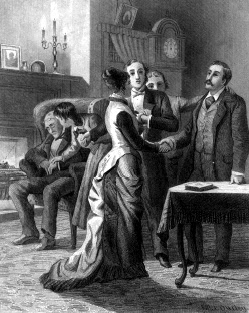
Illustration from Godey's Lady's Magazine, January 1880

Thursday, January 7, 2016

Letting In the Light

Photo Courtesy of Cali www.pixabay.com

Venetian Blinds

Late in the afternoon, when the sun makes its way into my study through the wide western windows, I sometimes pull a cord which closes the Venetian blinds and shuts out the sunlight, either completely or partially, depending upon my wishes and whims at the moment.

Of course, in keeping out the sun, I also intercept my view of the outside world, so that I cannot perceive what transpires beyond the thin panels of the blinds.

A certain man closed the shutters around himself, refusing to let the world into the inner sanctum of his own life. He became cynical, grouchy, anti-social and cantankerous. For a time those who knew him attempted to make their way in around the barriers, but after suffering rebuffs, they left him to his self-desired role of a recluse. With the years, his face became harder and more deeply lined with hatred for his fellow men. Then, at length, he committed suicide, leaving a note in which he complained of the injustice and unkindness of mankind. In pulling the blinds against others, he dwarfed his own soul. 

You cannot close the shutters without making the room darker.

Neither can you build around yourself a fence to keep others out, except you make your own soul smaller and your life an emptiness. For a man to have friends, he must himself be friendly.
--by Leo Bennett, from Sunshine Magazine, December 1961