Showing posts with label Warmth. Show all posts

Thursday, February 4, 2016

Homemade Vegetarian Soups


Photo by James DeMers (source)


In honor of National Homemade Soup Day, I'm sharing some recipes for warm vegetarian soups. The first three are my versions of classic soups; the fourth is adapted from a vintage creole recipe. Bon appetit!


CREAM OF BROCCOLI SOUP

§         8 ounces frozen chopped broccoli
§         2 tablespoons minced onion
§         ¼ cup flour
§         3 cups milk
§         1 tablespoon butter or margarine
§         Salt and black pepper, to taste

Cook broccoli according to package directions; drain, and set aside cooking liquid. In bowl, mix flour with milk until smooth.  Add to broccoli in saucepan and stir well. Add reserved cooking liquid, butter, minced onion, and seasonings. Cook over moderate heat, stirring occasionally, until soup is slightly thickened and flavors are well blended. Serve with croutons, if desired. Yield: 4 servings.


TOMATO BISQUE SOUP

  • 1 large (28 ounce) can crushed tomatoes
  • 1 can condensed tomato soup
  • 1 soup can full of milk
  • ½ small raw onion, chopped
  • ¼ cup grated Parmesan or Romano cheese
  • Seasonings to taste (garlic powder, basil, oregano, salt, black pepper, cayenne pepper, crushed red pepper flakes)

Place tomatoes and onion in blender or food processor and blend until just slightly chunky. Heat mixture in saucepan, and add condensed tomato soup, 1 can milk, and herbs and spices as desired. If you would like it spicy, add crushed red pepper flakes and/or cayenne. Stir frequently over low heat until done.  Just before serving, stir in cheese. Serve with croutons, if desired. Yield: 4 servings


PASTA E FAGIOLI

  • 1 cup olive oil
  • Crushed red pepper flakes, to taste
  • 3 garlic cloves, crushed
  • 1 stalk celery, chopped (optional)
  • 1 large (28 ounce) can crushed tomatoes
  • 2 cans cannellini beans (or one can of these and one can of red kidney beans)
  • ½ pound of uncooked small pasta, such as tubetti, ditalini or broken spaghetti
  • Salt and pepper, and dried basil, to taste
  • Grated Parmesan or Romano cheese

Coat bottom of small stock pot or Dutch oven with olive oil. Sauté garlic and red pepper flakes until garlic is golden. Add celery if using, and sauté a few minutes more. Then add crushed tomatoes and cook on low heat for 25 minutes. Add salt, pepper, and basil, and the beans with liquid. Let cook about 10 minutes more over low heat. Then add 4 cups of water and let come to a boil. Add uncooked pasta and let cook until pasta is al dente. Serve topped with grated cheese and more crushed red pepper, if desired. Yield: 4-6 servings.

 
POTATO   AND   WATERCRESS   SOUP (Potage Cressonniere)

§         5 Tbsp butter
§         2 medium onions, sliced
§         6 medium potatoes, pared and sliced
§         1 clove garlic, minced
§         ¾ cup water
§         2 bunches watercress, coarsely chopped
§         3 cups milk and water in equal quantities
§         1 cup light cream
§         Salt and pepper, to taste


Melt the butter in a deep saucepan. Add onions, potatoes, garlic, three quarters cup water, salt, and pepper. Cook very slowly until vegetables are soft and mushy. Add three quarters of the watercress. Add the milk and water and stir over heat until soup comes to a boil. Press mixture through a coarse strainer; or allow to cool and place in blender or food processor to puree. Return to the pan with the rest of the watercress. Add the cream, season to taste, and heat thoroughly. Yield: 4 to 6 servings
Adapted from The Art of Creole Cookery (1962)


Tuesday, January 19, 2016

Staying Warm-Coats of the 1900s-1930s

Engagement Days by Harrison Fisher (1905)

Winter fashions have changed through the years. But what hasn't changed is that women (and men too!) need to stay warm, and want to look stylish at the same time. Today, I am  highlighting some popular winter looks from the 1900s to the 1930s.

The illustration above is from a 1905 romantic postcard by Harrison Fisher. The woman is hiding snowballs from her unsuspecting fiancee. She is wearing a hat and gloves, but appears have on a heavy woolen sweater, rather than a coat. He is wearing a long overcoat, and is keeping his hands in his pockets to stay warm. The illustration below is a 1909 magazine cover, also by Harrison Fisher. The woman in this picture is following a trend of the times which seems odd and even repulsive now. She is carrying a fox fur muff, with an actual fox head as part of the design. Similar mink and fox head stoles remained fashionable until the1950s, and can still be found online and at vintage shops.


Magazine Cover by Harrison Fisher (1909)

Fashionable Lady With Mink Stole (1930s)

Fur coats, collars and accessories were very popular in the early 20th century, both for warmth and for style. This photo of Jack Johnson, who became the first African-American world heavyweight boxing champion, and his wife Emma, shows them dressed at the height of winter fashion in 1910. She is both carrying a fox muff and wearing a fox stole over what appears to be a fur coat. He has a beautiful fur collar on his wool coat, and may also be wearing a fur hat.


Boxer Jack Johnson and his wife Etta (Photo by E. Chickering- Courtesy of Library of Congress)


The images below show young women of the period dressed in furs. Of course, fur coats were expensive and not practical for everyday wear, but they conveyed style and elegance. Faux furs and other synthetic fabrics were not available, and wearing fur was not controversial the way it is today.


From T. Eaton Co. (Toronto) Fall and Winter Catalog 1913
 
McCall's Magazine Cover  (1911)


Postcard Image (Circa 1900-1910)


Fisk Tires Advertisement (1917)

Everyday coats were often made of wool, wool velour or velour plush, and sometimes trimmed with fur. The following catalog images show some beautiful coats of the late 1910's-early 1920s that were available in department stores in North America.


From Perry, Dame & Co. (New York) Winter Catalog 1919-1920

From T. Eaton Co. (Toronto) Fall and Winter Catalog 1920-1921


The following illustrations show multiple designs for winter outerwear from the 1920s and 1930s. The first two are French fashion plates. The other illustrations are taken from pattern illustrations of the period, showing garments that could be made at home.


From a 1920s French Fashion Plate

From an 1920's French Fashion Plate, designs by Suzanne Talbot

Winter Coats of 1928


1930s Coats, With Fur Collar or Trim

1930s Coat, With Fur Collar


1930s Coats, With or Without Belt


1930s Capes

Friday, January 8, 2016

A Warm Place

Photo Courtesy of splitshire.com

An evening of sweet contentment at the end of a busy week...a golden place outside of time where worries and concerns melt away, and friends are truly happy in each others company. Sometimes we try too hard to create these special moments. The magical times in life that we always remember often come when we least expect them. The following passage is a remembrance of a warm, happy get together with a group of seemingly random friends almost 100 years ago, on a rainy night in California....


Roses and Rain

     Last night we sat in the quiet room--a few friends together--and heard the wind rattling the palm leaves outside in the garden, like some ghostly senorita clicking a pair of invisible castanets in tune to some haunting rhythm.
     The fire burned on the hearth, a fire of eucalyptus logs, with now and then a branch of aromatic leaves, flaming suddenly into leaping life and filling the room with their pungent and somehow exotic perfume.
     We put out the bright lights from the center of the room, and let the shadows fall from the little gleaming lamps that are like fire-flies, flitting in the dusk like so many swiftly passing thoughts and pleasant memories.
     There we were, the young couple so dead in love with each other, and so full of the joy of living. Sweet Sixteen, a little terrified at her vague glimpse of life—Twenty-one, virile and modest and somehow eagerly hopeful.
     The Home Woman, the Woman of the World, the Artist, the Genius, the Singer and the Priest. A strange company, strangely mixed, and yet there we sat in the quiet little room—together, like passengers on a raft picked up from the wild sea and held together by some strange accident of fate.
     We talked, not of politics, not of war or of diplomacy—not even of the high cost of living, or of the effect of the vote upon women.
     We talked of books and poetry, and of music, and one told a quaint little story of a wounded pigeon, and the rescue of it, and the fire burned and the wind sang, and gradually the stress of the world and the anxiety and restless, uneasy ambition of it fell from us like an outworn cloak. And there we were, like little children, talking together in the twilight of some great primeval forest.
     And one sang—a simple song of love and memory and tears.
     “Roses and rain” and the Artist smiled, and the Woman of the World sighed, and there were tears in the eyes of the Home Woman.
     The Genius it was who sang—and the Singer sat by the fire and listened.
     The Young Wife’s hand stole to the hand of her Husband, and the Priest sat like one in a deep reverie. Was he thinking of the roses that bloomed in the dooryard of his home across the sea, and the fragrance of them in the sweet June rain?
     And we didn’t care who was elected or who was defeated, and somewhere, far down in the city below, the (news) boys were calling “extra, extra, extra!”—all about something or other very important, which concerned us not in the very least.
     And the Singer was generous, and poured out for us like a libation on the altar of friendship his voice of molten silver—French songs he sang full of the quick and glancing grace of a fountain leaping in the moonlight. German lieder, simple and brooding, like the lullabies a mother sings to her child. Italian, too, he sang, and the room glowed with the fire and the passion of the melting music of Italy.
     “Eileen Allana”—how he sang it—the simple old ballad, and how we drank every lilting note of it, like thirsty travelers in a dry and arid desert.
     And so the quiet evening spent itself, and at the end she sang again, the woman with the strange dark eyes—“Roses and Rain”—and we were one with the sunshine and the dew and knew again the sweet and rapturous pang of youth and moonlight and the mystery of the stars.
     “Roses and Rain”—the wind in the palm trees, the fire on the hearth, dear faces in the soft dimness of the quiet room. What is there sweeter, what more beautiful, what more to be gained in life than these?
 --from Roses and Rain by Annie Laurie (1920)


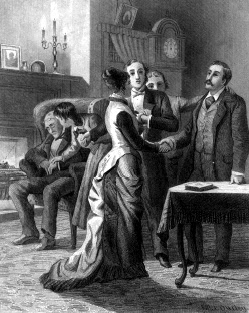
Illustration from Godey's Lady's Magazine, January 1880